
New fund offers collection in the current calendar year was the highest in a decade, with 13 of the 70 equity schemes cornering 75 per cent of the amount raised.

The combined wealth of India's dollar billionaires is now equivalent to 33.81 per cent of India's nominal GDP.

Riding on a bull run, equity investors became richer by Rs 128.77 lakh crore in the 2023-24 fiscal, driven by robust fundamentals of the Indian economy, increased investment inflows and promising corporate earnings. After a muted performance in 2022-23, equity markets made a remarkable recovery in FY24, giving handsome returns to investors. The 30-share BSE Sensex climbed 14,659.83 points or 24.85 per cent in 2023-24.

The number of dematerialised (demat) accounts required to hold shares and other securities in electronic format rose by 3.1 million in April, bringing the total tally to a fresh record of 154.5 million. Since December last year, the new additions have consistently remained above the 3 trillion mark, a sign that the stock markets continue to attract new investors despite a spike in volatility.

The story of the Bombay Stock Exchange and the people who shaped its growth: From wars and bomb blasts to speculators, reformers and wealth creators.

Global private equity (PE) firms are successfully offloading large equity stakes in domestic companies in the open market, taking advantage of buoyant conditions. Strong domestic liquidity support and an upward trending market have underpinned over a dozen PE exits worth $2.5 billion, data compiled by Business Standard shows. The figures exclude PE exits during maiden share sales and shares sold by strategic investors, such as SoftBank and Ant Group in new-age companies.
Stock market investors became richer by a whopping Rs 77.66 lakh crore in 2024, helped by an overall optimistic trend in equities, where the BSE Sensex surged over 8 per cent. Analysts said the year witnessed a tug of war between the bulls and bears marked by volatility but, despite the uncertainties around the world, the Indian markets sustained the pressure and delivered impressive returns.
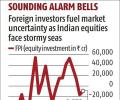
Foreign portfolio investors (FPIs) have withdrawn Rs 25,305 crore from domestic markets since September. FPIs were net sellers in the first two months of 2023, but from March to August, they purchased equities worth Rs 1.7 trillion. This selling trend has caused the National Stock Exchange Nifty Index to decline by 3.2 per cent from its September highs. FPI selling initially began in September as profit-taking but intensified due to rising US bond yields and uncertainty regarding the rate hike trajectory.

JSW Steel, owned by Sajjan Jindal, has emerged as the world's most valuable steelmaker, boasting a market capitalisation (mcap) of nearly $30.31 billion, according to Bloomberg data.

From the 30-share Sensex blue-chip pack, Tata Steel, Zomato, Larsen & Toubro, Tata Motors, Adani Ports, Tata Consultancy Services, HDFC Bank and NTPC were the major laggards. Nestle, Hindustan Unilever, Mahindra & Mahindra, Kotak Mahindra Bank, Asian Paints and Bharti Airtel were among the gainers.

Equity benchmark indices Sensex and Nifty settled lower for the sixth straight session on Monday due to heavy selling in bellwether stocks including HDFC Bank and Reliance Industries amid mixed trends in the global markets and outflow of foreign funds. Falling for the sixth consecutive session, the BSE Sensex tumbled 638.45 points or 0.78 per cent to settle at 81,050. During the day, it plummeted 962.39 points or 1.17 per cent to 80,726.06. The NSE Nifty slumped 218.85 points or 0.87 per cent to end at 24,795.75.

Trading sentiment in the equity market will largely be driven by domestic corporate quarterly earnings, any update related to US tariffs and foreign fund movements this week, analysts said. Investors would also focus on world market trends, movement of global oil benchmark Brent crude and the rupee-dollar trend for further cues, experts noted.

In September, JSW MG Motor India, the newly minted joint venture between SAIC Motor, which is present in 100 countries, and Indian conglomerate JSW Group, launched the Windsor, an electric car that introduced battery as a service (BaaS).

US strikes on Iran's three main nuclear facilities have once again raised concerns that Tehran might shut down the Strait of Hormuz - one of the world's most critical chokepoints, through which a fifth of global oil and gas supply flows.

From the Sensex pack, Asian Paints, NTPC, Reliance Industries, Tata Steel, Bajaj Finserv, Hindustan Unilever, Sun Pharmaceuticals, Adani Ports & SEZ, Axis Bank, Tata Consultancy Services, Titan and Bajaj Finance were the major gainers. Tech Mahindra, Kotak Mahindra Bank, Zomato, Tata Motors, and IndusInd Bank were the laggards.

Nestle, State Bank of India, Power Grid, Tata Steel, Larsen & Toubro and Mahindra & Mahindra were the other major gainers. In contrast, Tech Mahindra, Axis Bank and Reliance Industries were the laggards.

After a strong run in the midcap and smallcap indices, which surged 46 per cent and 43 per cent, respectively, on the National Stock Exchange (NSE) during Samvat 2080, analysts suggest that the rally in these segments may pause to catch its breath in Samvat 2081.

Bajaj Finserv, Infosys, Mahindra & Mahindra, Tech Mahindra, Hindustan Unilever, State Bank of India and HCL Technologies were the biggest gainers. On the contrary, Asian Paints, JSW Steel, NTPC and Adani Ports were among the laggards.

Among the Sensex firms, NTPC, Mahindra & Mahindra, Wipro, Kotak Mahindra Bank, Tata Steel, Asian Paints, Bharti Airtel, Power Grid, Titan and HDFC Bank were the major gainers. Bajaj Finance, Bajaj Finserv, Infosys, Tata Consultancy Services, Tata Motors and HCL Technologies were the laggards.
The rally in Indian mid-and smallcap indices thus far in calendar year 2024 (CY24) has been the best in class across the world, eclipsing the global FTSE benchmarks, and also out running peers from other leading world stock markets. This is despite the correction in the mid-and smallcap segments back home seen in the last few days, triggered by valuation concerns, geopolitical developments amid nervousness ahead of the July - September 2024 (Q2-FY25) corporate results season.

Geopolitical events, macroeconomic data and quarterly earnings of corporates would guide the stock market in a holiday-shortened week ahead, analysts said. Stock markets will remain closed on Wednesday for Ram Navami. "This week promises to be crucial for the market as fresh worries about a potential conflict between Iran and Israel emerge.

India Inc remains strong on foreign investors' radar with the private equity market in the country set to more than triple to nearly $7 billion by 2010, from $2.2 billion last year, a new study shows.

From the 30-share blue-chip pack, Bharti Airtel, Power Grid, Bajaj Finance, Nestle, Mahindra & Mahindra, Reliance Industries, Asian Paints, IndusInd Bank, Hindustan Unilever and HDFC Bank were the biggest gainers. Bajaj Finance climbed nearly 2 per cent after the company reported an 18 per cent increase in its consolidated net profit to Rs 4,308 crore for the December quarter.

State Bank of India, Adani Ports, Tata Consultancy Services, ICICI Bank, Reliance Industries and PowerGrid were also among the laggards.

Equity benchmarks Sensex and Nifty on Thursday gave up all early gains to settle lower as surging oil prices amid the ongoing conflict between Russia and Ukraine hit investor sentiment. The 30-share BSE Sensex started the trade on a higher note and jumped 527.72 points in morning deals to a high of 55,996.62. However, during the afternoon trade it surrendered all its early gains and finished at 55,102.68, lower by 366.22 points or 0.66 per cent.

The Indian markets have delivered high long-term returns, second only to the US.
From the Sensex pack, Tech Mahindra, HDFC Bank, Larsen & Toubro, ITC, Infosys, IndusInd Bank, Kotak Mahindra Bank, Titan and HCL Technologies were among the gainers. Maruti Suzuki India, Tata Steel, Bajaj Finance, UltraTech Cement, Nestle India, Axis Bank and Tata Consultancy Services (TCS) were among the laggards.

'Indian investors have always been debt-heavy but with growing financial awareness they are getting comfortable with equities.'

Investing is not just about setting aside money -- it's about making it work for you, says Ramalingam Kalirajan.

'What will matter in 2024 from the market standpoint is the direction of interest rates globally, as well as in India.' 'The results of the general elections will also be keenly watched.'

Foreign portfolio investors (FPIs) pulled out as much as Rs 17,537 crore from the Indian markets in just three trading sessions of March as investors' sentiment got dented by the uncertainty triggered by the Russia-Ukraine conflict and rising crude oil prices. As per depositories data, they pulled out Rs 14,721 crore from equities, Rs 2,808 crore from debt segment and Rs 9 crore from hybrid instruments between March 2-4. This took the total net outflow to Rs 17,537 crore.

Investors' wealth jumped over Rs 59.75 lakh crore in the 2021-22 fiscal, helped by a largely buoyant trend in domestic stocks with benchmark index Sensex surging over 18 per cent during the period. Braving many headwinds in the latter part of the current fiscal, Sensex closed the 2021-22 financial year with a gain of 9,059.36 points or 18.29 per cent. Mirroring optimism in equities despite worries related to geopolitical tension, inflation concerns, FII selling, the market capitalisation of BSE-listed firms rallied by Rs 59,75,686.84 crore to Rs 2,64,06,501.38 crore in the entire 2021-22 fiscal.
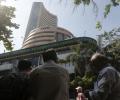
Among the 30 Sensex firms, Mahindra & Mahindra, IndusInd Bank, Bharti Airtel, Axis Bank, Tata Motors and ICICI Bank were the biggest laggards. In contrast, Tata Steel, Tata Consultancy Services, NTPC, JSW Steel, Asian Paints and Reliance Industries were gainers.

The value of the foreign portfolio investors' (FPI) holdings in the domestic equities reached $667 billion in three months ended September 2021, a surge of 13 per cent from the preceding quarter, according to a Morningstar report. This was largely on the back of strong performance by the Indian equity markets along with net inflows from FPIs at the later part of the quarter. "At the end of the quarter ended September 2021, the value of FPI investments in Indian equities shot up sharply to $667 billion, which was considerably higher than the $592 billion recorded in the previous quarter, a spike of around 13 per cent," the report noted.
Among the Sensex firms, UltraTech Cement, Reliance Industries, ICICI Bank, HDFC Bank, Bharti Airtel, IndusInd Bank, State Bank of India, Tata Consultancy Services, Larsen & Toubro, Kotak Mahindra Bank and State Bank of India were the major gainers. In contrast, Tata Motors, Maruti, Axis Bank, Mahindra & Mahindra, ITC, NTPC, Tata Steel and Bajaj Finserv were the major laggards.

The rupee tumbled 3 per cent against the US dollar in 2024 as concerns over slower economic growth and a stronger greenback in global markets weighed, but it was among the least volatile currencies in the world and the headwinds may be less intense in the coming year.

From the Sensex pack, Reliance Industries, Bajaj Finserv, HDFC Bank, Adani Ports, Maruti Suzuki India, Axis Bank, Hindustan Unilever, Sun Pharmaceuticals and Asian Paints were among the laggards. Reliance Industries fell the most by 2.38 per cent to close at Rs 1,171.10 apiece.

The sharp rally in the midcap stocks has made valuations expensive, and there is room for a correction, wrote Christopher Wood, global head of equity strategy at Jefferies in his latest note to investors, GREED & fear. The midcap index, Wood said, now trades at 24.1x 12-month forward earnings compared with 18.7x for the Nifty. Rising crude oil prices, he believes, are another worry for India, which imports nearly 80 per cent of its annual crude oil requirement.

Smaller stocks have emerged as Dalal Street's favourites in 2023 that has turned out to be a "great year" for equities, rewarding investors with big gains, driven by optimism over the country's macroeconomic fundamentals and heavy retail investors participation. Experts said equity markets are experiencing a prolonged bull run and it is during this time that the midcap and smallcap segments tend to outshine their larger counterparts. Till December 22 this year, the BSE smallcap gauge has jumped 13,074.96 points or 45.20 per cent while the midcap index has surged 10,568.18 points or 41.74 per cent.

India's stock markets are experiencing a shift in investor sentiment, with a 30 per cent surge in Chinese stocks, prompting investors to move money from domestic markets to China. This reversal of fortunes is a notable change from the past three years, where China's losses benefited India.
